Interests
My interest mainly lies in the application of numerical and computational methods in geodynamics and planetary physics, in particular, high-performance computing and analysis of large datasets.
Numerical Methods for Astrophysics:
« Optimizations of the symplectic integrators for solar system simulations »
- Implementation of SIMD on single processors using AVX intrinsics in REBOUND’s WHFast (Rein & Tamayo, 2015) integrator
- Required hardware: AVX-enabled CPUs
- Supervisor: Prof. Hanno Rein
This project was later pursued, resulting in the development of «WHFast512» integrator:
WHFast512 is the “current record-holder for fastest solar system simulations”. Sam Hadden has compiled a brief overview of N-body simulations, speeds, and CPU clock rates, as well as a very interesting plot comparing integrators and CPU speeds since the 1950s.
For a detailed description of its implementation, please refer to:
Computational Fluid Dynamics [Undergraduate Project]:
« Solving for isoviscous infinite Prantdl number convection: application of finite volumes and finite differences methods in a two-dimensional Cartesian system »
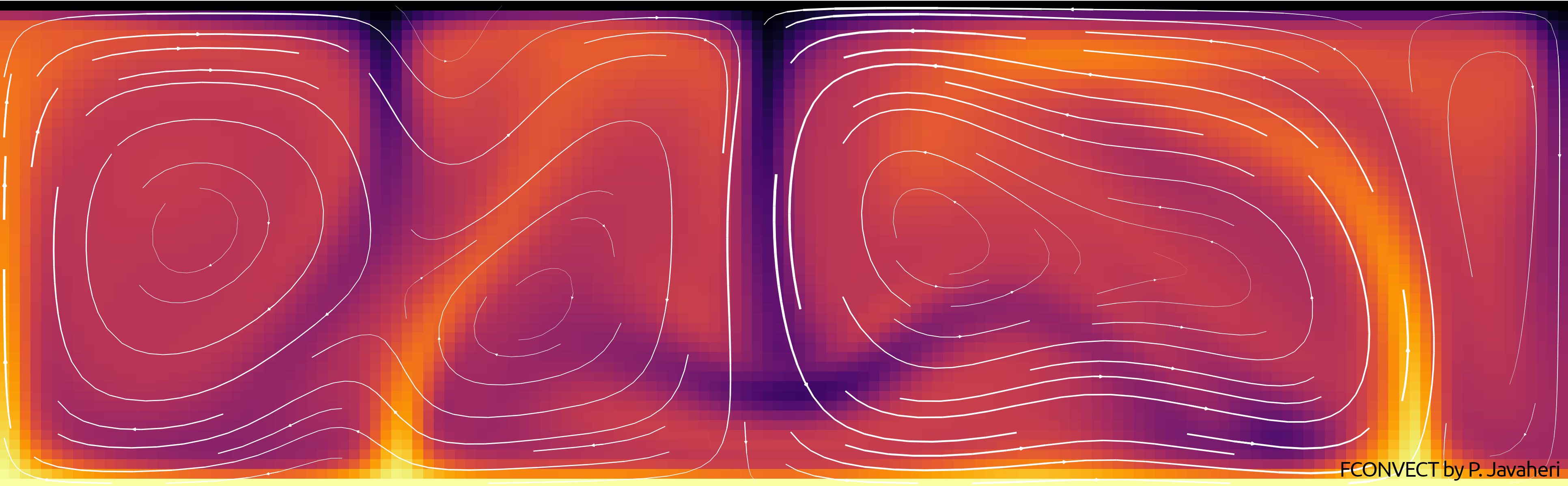
- Implemented fully in Fortran
- Equally-spaced Eulerian discretization with interpolated staggered grid points
- Using LSQR iterative solver by Paige, C. C. and Saunders, M. A. (1982)
- Supervisor: Prof. Julian Lowman
Geophysical Data Analysis:
« Candidate plate detection and identification of diffuse and non-conforming regions »

- Implementation of the Random Walker (RW) algorithm (Grady, 2006) on a spherical grid
- Ease of use with a Python interface
- Optimized for speed with backend functionalities implemented in C
- Documentation
- Python Packaging Index (PyPI)

- See PlateRecipy for a guide
For a detailed description of its implementation and use, please refer to: